
What You Actually Need to Know
Let’s be honest, visuals can make or break an event. The screen setup either delivers the goods or leaves your client squinting at washed-out PowerPoint slides while pretending to be impressed.
When it comes down to it, there are two main players in the game: projectors and LED screens. Both have their uses. One just has a lot more wow factor.
Projectors: The Old Faithful
If you’re working with a tight budget, a dark room, and not too many surprises, projectors still pull their weight.
Good for:
-
Budget-conscious events
-
Dark venues where brightness isn’t a battle
-
Flexible setups with minimal crew
Downsides:
-
Weak performance in bright rooms
-
Anyone walking in front of the beam = instant shadow monster
-
Needs careful alignment and tweaking to look decent
Think: simple conferences, community halls, or one-off slide decks where no one’s filming and no one’s expecting the Sydney Opera House.
LED Screens: The Showstopper
If your event needs to impress. On camera, in daylight, from every seat in the room. LED is the way to go. It’s what we use when we really want your content to shine.
Great for:
-
Bright rooms, outdoor events, or venues with full lighting
-
Seamless visuals with no shadows or focus fuss
-
Events being filmed or streamed, zero flicker
-
A polished, premium look that clients notice
Things to keep in mind:
-
Higher upfront cost
-
Takes longer to set up
-
Needs trained crew to assemble, calibrate and run
But you’re not just renting gear, you’re buying peace of mind. This is a screen setup that won’t ghost you mid-event.
Why LED Costs More (and Why It’s Worth Every Cent)
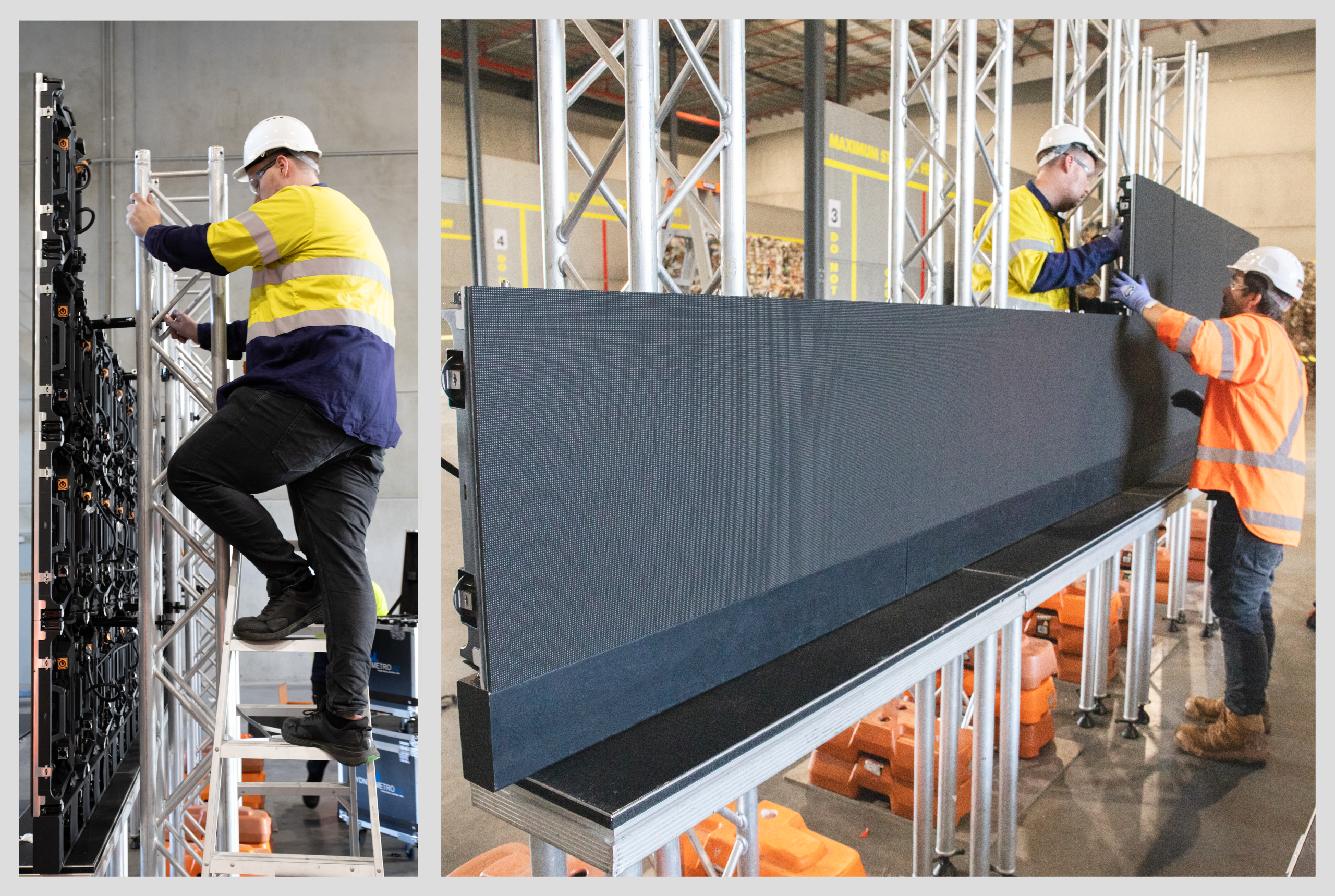
Here’s the real story: LED screens aren’t plug-and-play. They’re engineered builds.
We’re talking:
-
Custom panel layouts
-
Signal routing
-
Frame syncing
-
Colour calibration
-
On-the-fly media scaling
-
All wrapped up in a system that just works from bump-in to pack-down
It’s a big setup. But that’s what makes LED screens look world-class. Because they are.
Wait, What’s Pixel Pitch and Why Should I Care?
Glad you asked.
Pixel pitch is the space between each tiny LED on the screen. The smaller the gap, the more LEDs per panel and the sharper the image.
Here’s a cheat sheet:
-
A 3.9mm panel = solid quality, more budget-friendly
-
A 2.9mm panel = higher resolution, more LEDs, higher price
So why would you go smaller? Viewing distance.
If your audience is close to the screen (like in a conference room or intimate stage setup), you want a tighter pitch to avoid seeing the tiny gaps between LEDs.
But if they’re sitting 15 metres back? No need to go all-in on the fancy panels. You can save money with a wider pitch and still get a great result.
Basically:
-
Closer crowd = smaller pitch
-
Farther crowd = save your budget
Don’t worry, we’ll work this out with you. Just tell us the room, the vibe, and how close the audience is, and we’ll spec the right screen. Simple.
How to Choose
Here’s how to break it down fast (and explain it to your client without the tech talk):
-
Need to wow in a bright room or film the event? LED. Every time.
-
On a budget in a dark venue? Projector still gets the job done.
-
Don’t know what to pick? We’ll figure it out with you. No guesswork
Want a Client-Friendly One-Pager
We’ve wrapped all of this into a clean, non-techy PDF you can flick to your client. Just the essentials. No waffle.
Pop in your name and email, and it’ll land in your inbox, ready to go.
×
Client’s Asking “LED or Projector?”
No tech waffle. Just the essentials your client actually needs to know. One download. Instant clarity.
0 Comments